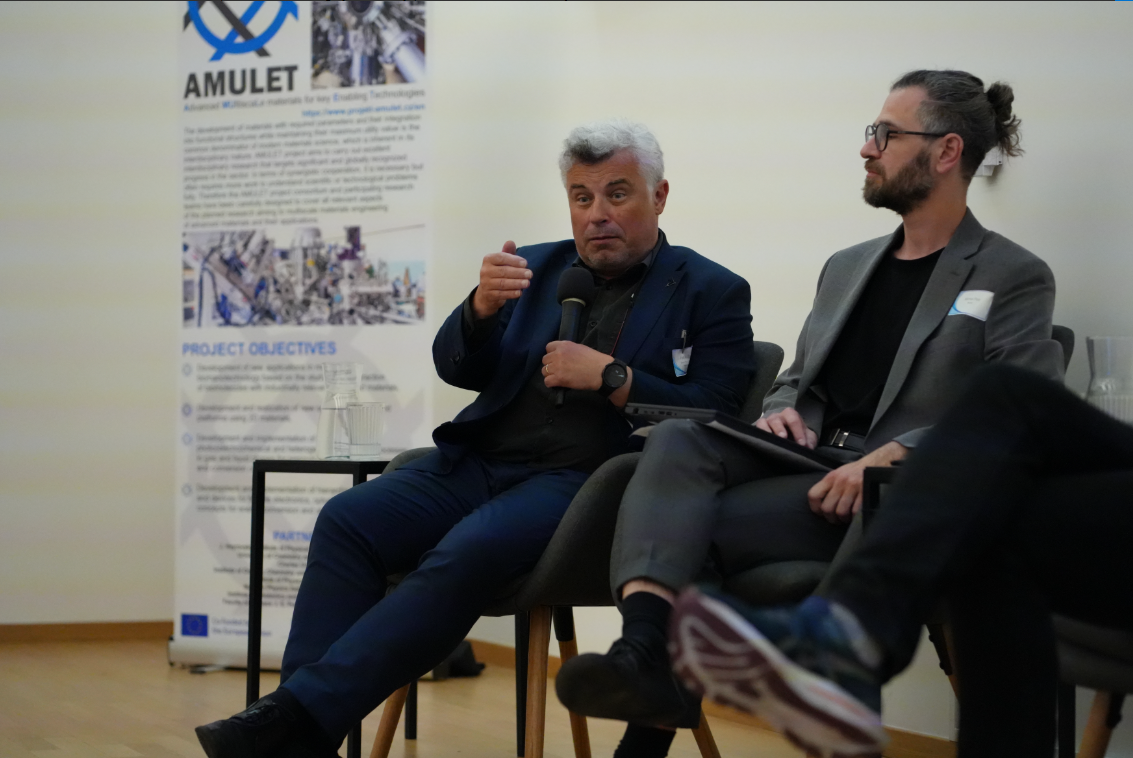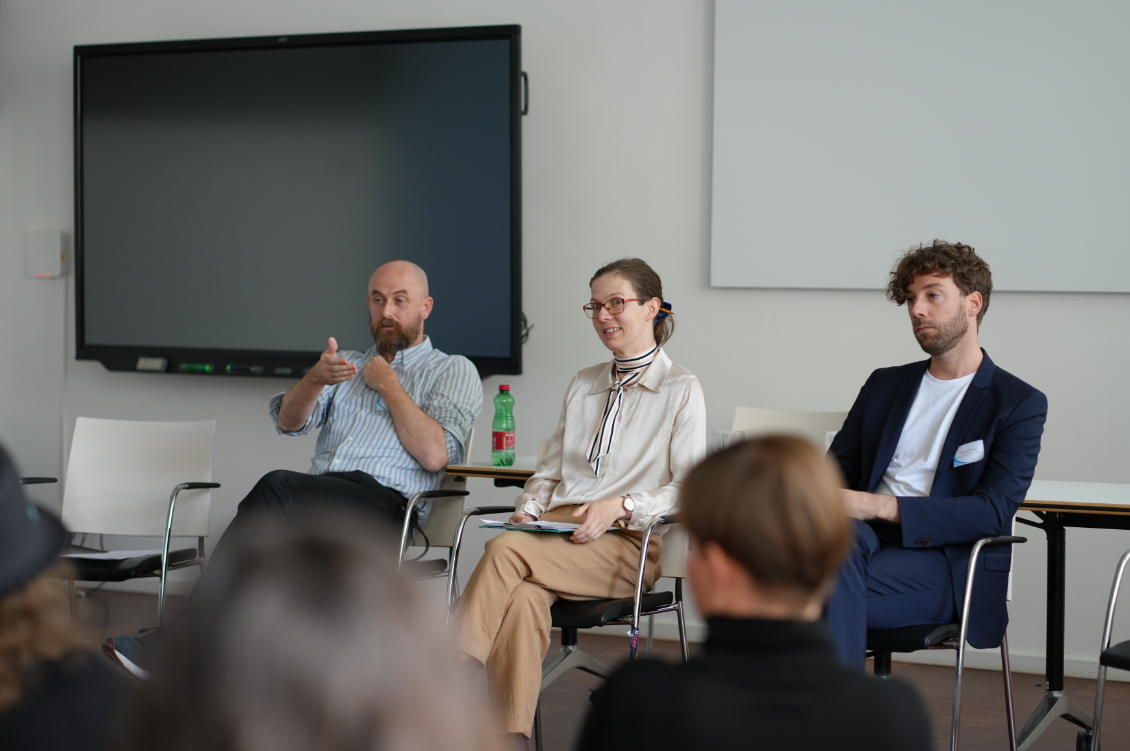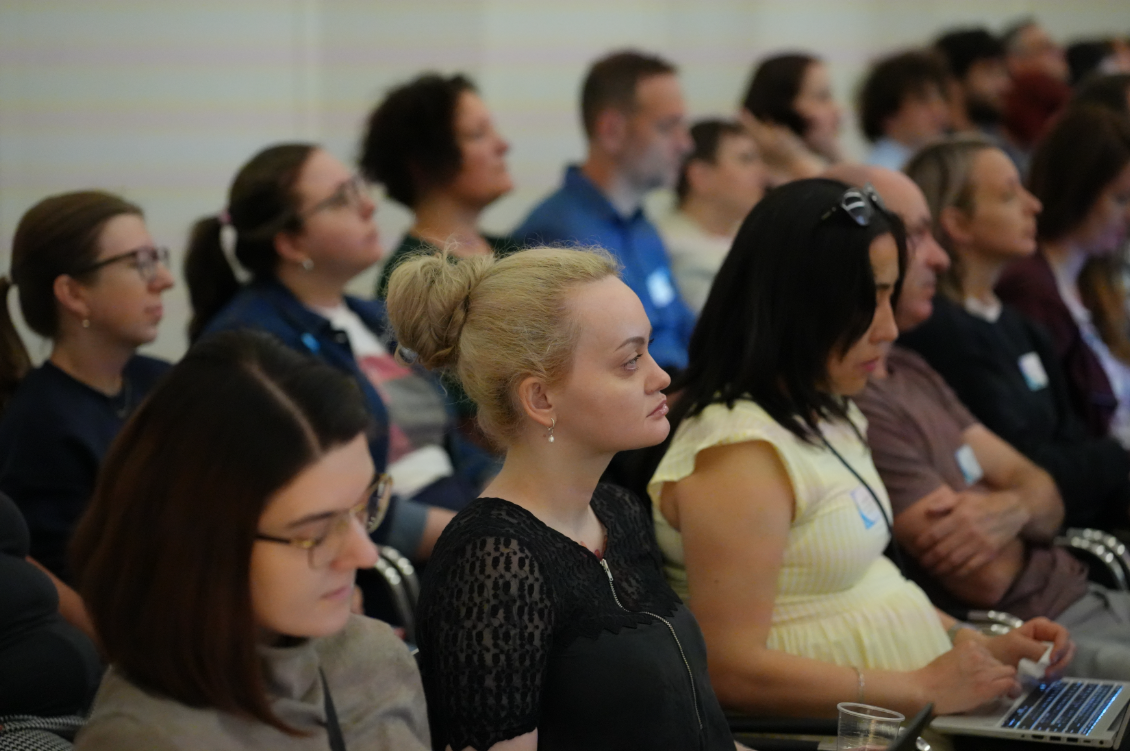


Does science evaluation need a (re)vision? That was just one of the many burning questions tackled at the conference ‘Re:vision of Science: From RDM to Evaluation Reform’, which took place on June 11 at the FZU. Guest speakers from across the Czech Academy of Sciences’ institutes and Czech universities as well as international keynote speakers shared best practice in open science, but also raised important points that need to be solved – such as the future of responsible data sharing and building truly global, resilient infrastructures.
FZU director Michael Prouza opened the event by emphasizing the history and importance (but also the occasional pitfalls) of open science. Some scientific fields such as astrophysics saw an early advent of open science thanks to preprint sharing platforms like arxiv.org and commonplace data sharing. In other fields, however, open science practice is still uncommon. Data policy can help bridge this gap and ease the transition – but how do we draft good policy?
Jaroslava Škudrnová (Institute of History), Ivan Tarant (HiLASE centre at the FZU) and Marek Cebecauer (Heyrovský Institute) shared their institutes' data policy – how it originated, what is transferrable elsewhere and what still needs to be improved. From data policy, the topic at hand moved smoothly to large data infrastructures such as the geophysical EPOS (European Plate Observing System) ERIC, introduced by Jan Michálek (Institute of Geophysics), Jana Synovcová Borovičková (Institute of History) presented Nodegoat Go, which enables historians to study people, artefacts and resources in context, and Barbora Rolečková (Institute of Vertebrate Biology) showcased institutional as well as wider infrastructures for sharing – not only – genetics and genomics data. All three then dove into more detail of the systems at roundtables in the foyer, with every participant being able to ask more questions.
Researchers submit their data to these infrastructures – but what if it’s citizens who record data? How do we sift through it and ensure everything is correct? Matyáš Adam from the Tomas Bata University in Zlin gave a stimulating talk on citizen science, its relation to open science and data management, and on his field of ecoacoustics – one that generates a lot of diverse data that needs to be managed with care.
That was already a lot to discuss during the lunch break, but the event was far from over – it was time for the international keynote speakers to bring in fresh perspective. Can the Czech Academy of Sciences find inspiration in open science practice at the Helmholtz Association, as presented by the head of Open Science Office at Helmholtz, Mathijs Vleugel? For instance, the Helmholtz Association surveyed researchers about their expectations of what is being evaluated, and their opinions about what should be evaluated. This inspired a new hiring and evaluation approach.
Most importantly, what is the future of open science? That was a question posed by Gareth O'Neill (Technopolis Group), in his inspiring talk that covered open science from data sharing enabling to reveal fraud to the dangers of sharing too much data with little regard to the risk of its misuse much later (for a prime example outside of purely research data context, think of Cambridge Analytica and Facebook users). In the later discussion, both Gareth and Mathijs answered the participants’ questions and dove deeper into the present and future of open science, including its relationship with research evaluation.
Research evaluation and CoARA (Coalition for Advancing Research Assessment) were also the subjects of a panel moderated by Tereza Szybisty (OpenAIRE AMKE), with both keynote speakers, Michal Petr (Masaryk University) and Patrik Španěl (Heyrovský Institute) as panelists. The next panel on data repositories was moderated by Marek Cebecauer, who was joined by Antonin Fejfar (Institute of Physics) and Vojtěch Malínek (Institute of Czech Literature). Last but not least, Radka Římanová, Zuzana Škardová and Irena Kozmanová from the Charles University led the Dilemma Game workshop - a wonderful tool for examining academic publishing, decision-making and integrity in a card game environment.
Hopefully, the conference was a source of inspiration to all participants, who came from institutes and universities across the country and across fields from physics, chemistry and biology to history and even filmmaking.
---
The conference, organized by the FZU Scientific Library at Cukrovarnická, was supported by EOSC CZ and the AMULET project. We thank the partners for their support. A recording of both main sessions will be soon added to the FZU YouTube channel.
---
Adapted from www.fzu.cz. Author: Julie Nekola Nováková, Institute of Physics of the Czech Academy of Sciences